

Last updated: Monday, August 31, 2026
You may now walk across almost any industrial floor. Employees may wear safety glasses on their foreheads, around their necks, or beneath their shirt collars.
Safety managers frequently issue written reports or strict rules. Yet penalties rarely solve the real problem. Forced compliance creates friction and fails when supervisors step away.
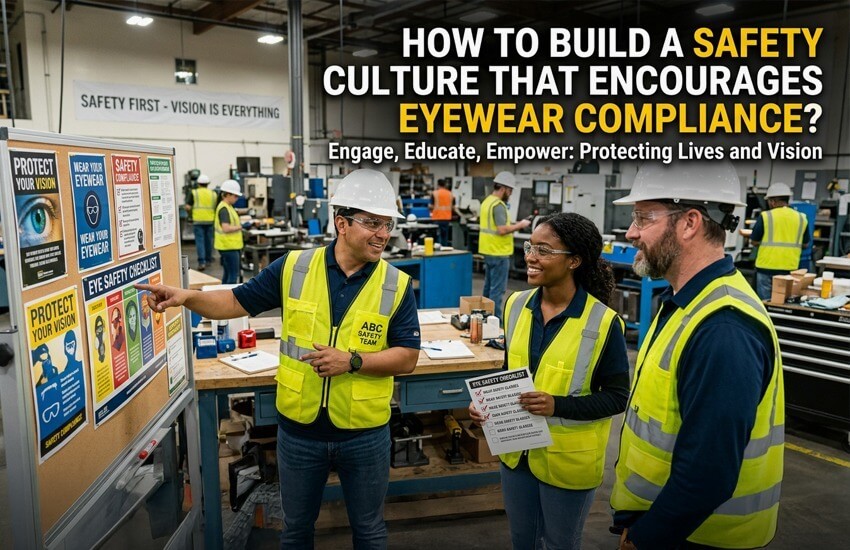
Building lasting compliance requires building a real safety culture. When workers value their vision and trust their equipment, wearing protective gear becomes second nature.
Transforming your workplace culture requires understanding why workers drop their eye protection. Addressing daily physical barriers and updating your safety program makes it easier for employees to follow safety practices.
Building better compliance starts with understanding what encourages employees to follow safety practices and what makes them resist them.
Three Pillars of a True "Safety First" Culture
A workplace can have excellent safety rules and still struggle with compliance. The daily application of those principles is usually what makes the difference. Supervisors and employees watch each other and listen to others. They also notice whether management responds when protective equipment creates problems. A real safety-first culture brings these elements together.
Pillar 1: Coworkers encouraging safe behavior
Safety starts with the people on the plant floor. If team members are looking out for each other, compliance becomes a team effort.
Encourage workers to speak out if they see a worker working unprotected. Discuss mutual care rather than correcting errors. A worker reminding a co-worker to lower their safety shield to avoid severe injury.
This support creates a powerful protective net over time, which will last beyond any supervisory audit.
Pillar 2: Leading by Example
Safety rules only work when leaders follow them too. All visiting clients, plant executives, and supervisors must be fully protected upon entering an active work zone.
Employees notice when a manager enters a dangerous area without wearing safety glasses. That one error is enough to destroy the program's credibility.
Employees will behave appropriately when they see the company's dedication to eye protection as a core value.
Pillar 3: Positive Recognition
Penalties encourage resentment and conceal non-compliant behavior. When employees do things correctly, it fosters trust and promotes safe work practices.
Recognize teams with excellent safety records. Encourage employees to identify hazards or assist their peers in selecting appropriate personal protective equipment.
Motivation Strategy | Traditional Enforcement | Positive Recognition Culture |
Primary Driver | Fear of fines or write-ups | Shared pride in personal safety |
Worker Reaction | Hide eye protection removal from bosses | Remind employees to wear protection |
Long-Term Impact | Temporary compliance under observation | Permanent daily safety practices |
Physical Barriers to Compliance (Why Workers Remove Their Eye Protection)
Safety equipment is hardly ever neglected because people are lazy. The majority of non-compliance is due to real physical discomfort, lack of visibility or poorly fitting frames.
Physical Barrier | Operational Consequence | Cultural Impact |
Lens Fogging | Workers remove glasses to wipe lenses mid-task. | Exposes eyes to sudden, unpredictable flying debris. |
Poor Frame Fit | Frames pinch ears or constantly slide down the nose. | Drives distraction and tempts workers to leave gear off. |
Vision Strain | Uncorrected vision causes headaches and fatigue. | Decrease overall work precision and increases error rates. |
Lens Fogging
Fogged lenses block vision entirely, turning protective gear into an immediate hazard. When temperature changes or physical exertion clouds their sight, workers naturally pull off their glasses to see their work.
Learn more about these daily vision hazards and how high-risk environments can aggravate them with industry-specific safety strategies in Protecting Your Workforce: The Role of Safety Glasses in High-Risk Industries.
Anti-fog lens coatings minimize heat trapping so that lenses remain crystal clear in extreme shifts.
Poor Frame Fit
Cheap, bulk safety glasses actually hurt your compliance program. The size and shape of human faces vary widely.
Poorly fitting frames squeeze nose bridges, press against temples, and slide off sweaty faces. Headaches and facial fatigue start within hours of uncomfortable eyewear.
Providing adjustable frames and multiple size choices solves physical discomfort fast.
Vision Strain
Over one-third of industrial employees require daily vision correction. Forcing these employees to wear bulky over-the-glasses goggles creates severe glare and eye fatigue.

Uncorrected vision leads to mistakes, slow production, and physical fatigue. Integrating vision correction into certified protective frames restores clear sight and daily comfort.
Simplify Your Program with Eyewebsafety’s Prescription Safety Solutions
Managing corporate eyewear programs across multiple departments or facilities often creates massive administrative burdens. Eyewebsafety simplifies corporate eye protection through fully digital management systems.
Their custom corporate portal streamlines employee eligibility, frame selection, and optical approvals in one place. Employees get access to top-rated safety frames fitted directly to their specific prescriptions.

Upgrade your corporate prescription safety eyewear program and stop the awkward over-the-glasses goggles completely. Workers get lightweight, high-impact ANSI Z87.1 certified glasses customized to their face shapes and job duties.
Eyewebsafety also supports a 3 M prescription safety eyewear program. This combination offers workers trusted industrial frame designs alongside advanced lens coatings that eliminate fogging and scratches.
Program Feature | Traditional Manual Ordering | Eyewebsafety Managed Portal |
Ordering Process | Paper forms & manual billing | Fully automated digital portal |
Frame Choices | Limited generic styles | Wide variety of ergonomic ANSI frames |
Compliance Tracking | Difficult paper record-keeping | Real-time digital eligibility logs |
Final Words
Building high eyewear compliance requires replacing old punitive rules with genuine support, comfortable gear, and active education. Addressing physical barriers like lens fogging and poor frame fit removes the reasons workers pull off their gear.
Updating your safety program through customized prescription solutions makes eye protection comfortable and effortless. When employees receive gear that fits well and provides clear vision, safety compliance becomes a natural daily habit across your entire plant floor.